
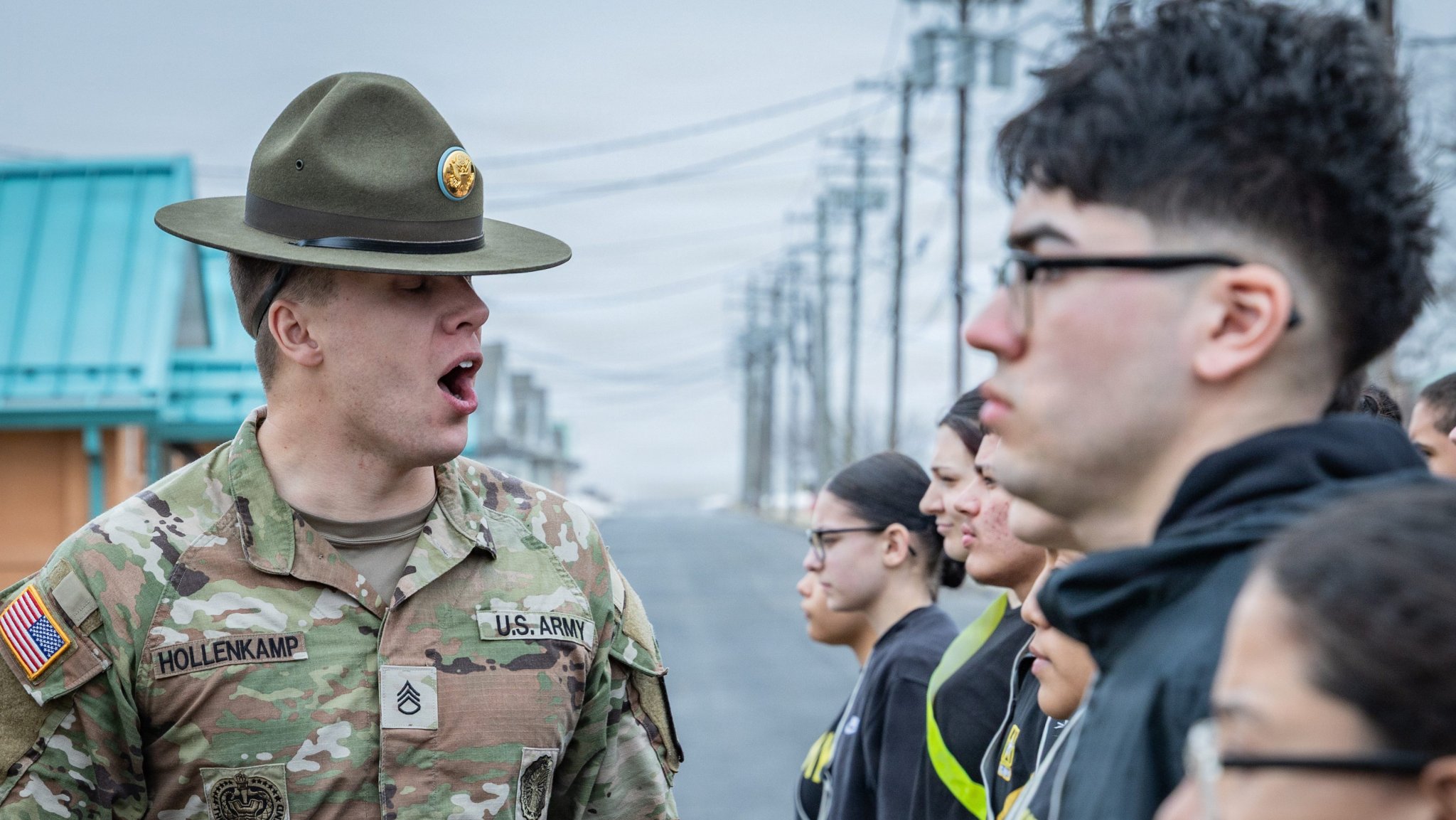
A major update to Army recruiting regulations this week raises the maximum age a recruit can join to 42, and removes a barrier to joining for recruits with a single legal conviction for marijuana or drug paraphernalia possession.
The Army’s previous limit was 35, though exceptions are occasionally made. The higher age limit brings the Army in line with other services’ limits of 41 in the Navy and 42 in the Air Force and Space Force, Kate Kuzminski, who studies military recruiting for the Center for a New American Security, told Task & Purpose.
Army recruiting officials have noted in recent years that the average age of recruits is increasing, with officials telling reporters in 2024 that the average recruit was 22 years, 4 months, and that it was still “going up.”
Kuzminski said the change has positives and negatives. According to a report she authored for the RAND Corporation, many older recruits scored higher on enlistment qualification tests than recruits who joined before 20. Those older recruits were also more likely to reenlist and be promoted than their younger peers.
However, older recruits were also less likely to graduate from basic training and had higher attrition rates.
The older enlistment cap is the latest in the military’s multi-billion-dollar overhaul of recruiting, launched after years of missed recruiting goals. The Army, the largest branch in the military, failed to meet annual recruiting goals in 2022 and 2023. Changes in recent years to the Army’s recruiting enterprise include installing a pre-boot camp prep course for recruits who do not initially meet fitness and academic standards and creating marketing schemes to move the Army’s messaging past the post-9/11 wars and appeal to Gen Z.
The changes also reflect an evolving Army workforce with more education and job skills. In 2024, then-Army Secretary Christine Wormuth announced that the service’s goal was to have one-third of the entire force to hold college degrees. For officers, the service has expanded its direct commissioning program for professionals who have worked in the tech sector for a few years and have expertise in artificial intelligence and space, in order to help bolster the Army’s technical knowledge across its formations.
Col. Angela Chipman, chief military personnel accessions & retention division said the enlistment age increase reflects the need for technical talent, even in the enlisted force.
“We’re kind of looking at a more mature audience that might have experience in technical fields,” Chipman said. “We need warrant officers with extreme technical capabilities, and those will come from the enlisted ranks.”
Marijuana laws vary between states
The Army also changed a specification in its waiver process for drug offenses. According to the regulation, recruits no longer need a waiver for a single conviction of possession of marijuana or possession of drug paraphernalia like bongs, roach clips, miniature spoons, and various pipes.
Under the previous regulation, a recruit with one conviction for possession of marijuana or drug paraphernalia required a waiver from officials in the Pentagon. Recruits also previously had to wait 24 months to enlist, and would have to pass a drug test at a Military Entrance Processing Stations facility before their waiver could be approved.
Kuzminski said the waiver modification “accounts for changes in society.” She noted that the change is for a single offense but that recruits with a “pattern” of convictions or behavior would still need a waiver.
“The updated regulation allows for one mistake, which likely represents the bulk of potential recruits who previously needed a waiver for marijuana use considering use in the Army,” Kuzminski said. “Reducing the number of characteristics that need to be reviewed for waivers frees up capacity for other candidates who need waivers, thus speeding up the process across the board and helping to ensure that the Army does not lose interested candidates.”
The looser approach to marijuana use comes as the broader military tightens its drug policies for troops currently serving. In recent years, the military added psychedelic mushrooms and products with kratom and related substances to its list of banned substances. Earlier this week, the Army said it will begin flagging all soldiers with positive drug tests — not just those with security clearances — to the Defense Counterintelligence and Security Agency.
And both Republican and Democratic in Congress have signaled a more lenient approach to recruits’ marijuana use — which is legal for recreational use in almost half of the U.S. and legal for medical use in the majority of states.
“It’s just us looking at, as the states continue to legalize marijuana versus those that don’t, and the federal government not yet legalizing,” Chipman said, “at what point are we hindering ourselves by holding people to this type of conviction that in some states is okay and some states isn’t?”
Recruit waivers reviewed at lower levels
The regulation, which governs the enlistment process for active duty and Reserve components, also codifies a change made in January, which put Army Recruiting Command in charge of waivers for recruits with mental health or misconduct histories. Now, two and three-star commanders who are in charge of street-level recruiters, rather than the Army Secretary level, will approve or deny major misconduct waivers for an offense.
Chipman said waivers were being approved at a 95% rate so the higher approval authority created an “unnecessary administrative burden.”
“The standards, when it comes to felonious behavior, that has not changed,” she said. “We’re not going to lower that.”
Loading comments…
Comments couldn’t be loaded. Please refresh the page.